14 Ways the Moviegoing Experience Was Radically Different Before 'Jaws'
Many of these are unimaginable for anyone under 60.

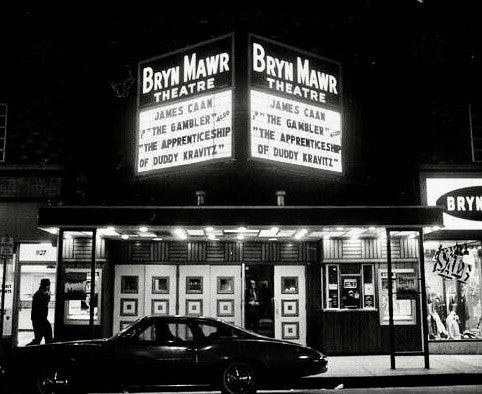
Bryn Mawr Theatre, Chicago, 1974
Whenever I want to shock moviegoing friends from younger generations, I ask them (particularly if they are under 40) how old they were when they first went to a movie without adults taking them. That is, got to the theater with only friends/siblings their age on their own (or alone), not dropped off, not picked up.
For me, around 8. Walked a half mile from my house (as I did to and from school daily from first grade on my own). Today I doubt most theaters would sell them tickets. Maybe they’d alert the authorities. For those of us who did, the moviegoing habit was engrained early and as something we did on our own. That seems important.
That’s the first of multiple ways rarely spoken about, or perhaps even known by today’s theater audiences about how the experience is much different today. Last week I wrote about some of the issues apart from early release of films to home platforms that may be affecting, often hurting, grosses. That led to making comparisons with what it’s like today to my formative days (teens and early adulthood) when I was going to the movies multiple times a month.
Let’s make 1975 - the year “Jaws” changed the landscape with its wildly successful A-theater same day across the country release - as the before and after point. That paralleled the rapid growth of multi-screen theaters, a rarity before 1970, and not the norm until the 1980s. (I started as a film buyer in Chicago in 1976 post-grad school.)
In no particular order these are some subtle and not so subtle differences:
Few films have I ever wanted to see more than Disney’s “Swiss Family Robinson” when in played my town’s only theater in 1961. But then I got chicken pox and missed its one week engagement. That meant I had no chance of seeing the film for years. The same thing in lesser degrees was a normal experience for most people. Complain about early windows (with reason), but before VCR arrived in the laye 1970s, the next chance came when network tv showed top films usually three years or more after.
Theaters then represented the only way one could see films in their correct aspect ratio, uncensored, uninterrupted by ads, and otherwise uncut. VCR improved things, but for many years they were presented in the wrong aspect ratio.
In numerous ways, movie theater auditoriums today are cleaner, more comfortable, with better sightlines and sound than 50 years ago. But they also miss an important element common back then. At a time when most theaters were still single screens, individual ones had distinct personalities, perhaps idiosyncracies that were more endearing than annoying. I can still identify specifics, even down to particular smells (not meaning unpleasant) decades later at those I went to most often. That distinct experience years later is something I miss, a lot, even with the improvements.
Advance ticket buying then was reserved for a handful of months-long exclusive downtown theater runs of “roadshow” movies (usually epics and musicals). Going to the movies was more spontaneous. Now, pre-planning is the norm. Something feels lost.
This might seem silly, but to me is important. One used to look up at the screen in most theaters. Now with stadium seating (and yes less blockage for sure) one looks at the screen. It makes the experience less immersive (apart from on the average small screen sizes).
Before the feature, one to (rarely) three trailers. Maximum. No ads.
Double features at many theaters. Not the prime ones usually, but at those with lower admission prices. I went to many (and discovered a lot of random movies) from childhood through college.
In the digital vs film debate: wear and tear in prints beyond initial dates (prints were sent around the country, often beaten up by the time they got to later theaters) is a thing of the past (as are issues like reels shown in the wrong order), but I still notice a less immersive feel from digital than I got from 35mm film.
By 7th grade I had moved to an urban area, so even though I was mostly limited to theaters within walking distance, proximity to more was possible. Unlike today, most studio movies had a lifetime in local theaters that could extend to months, in some major cases more than a year. Most were released in stages, not all theaters at one time, then often gone in less than a month (with a sense of disposeability far greater now).
Part of individual theaters’ distinctiveness was their audience make up. The concept of “neighborhood theaters” as was frequently used conveyed the idea of a much more diverse crowd attending from the perspective of age, gender, race, ethnicity, other elements.
Audiences behaved better, and when they didn’t, single screen theaters usually were adequately staffed to deal with any issue.
Individual theaters were programmed for their specific audiences, as opposed to the one size fits all (or most) where what is shown is often more determined by the number of screens (how many of current releases can play) rather than what works best for a specific audience.
For a lot of reason - trailers that left a lot of mystery rather than summarize a plot, no TV advertising (network and locally nearly nonexistent before 1975), obviously no social media - the content of a movie was a far greater mystery than now. Add to that most films were originals, not sequels or franchise connected. The first studio movie sequel with a number designating it as such - ever - was 1974 (“The Godfather Part II.”) Prior to then it was considered too tacky to consider.
The Bryn Mawr Theater pictured above was located on Chicago’s north side about three miles north of Wrigley Field, in a densely populated neighborhood a short distance from Lake Michigan and next to an El station. During my college years I often went on weekend (45 cents train ride, 30 minutes) to see late-run double features (they were great at picking up lesser shown titles). Admission? 60 cents ($4 today).
The theater had 790 seats. That is larger than most auditoriums today, but was considered mid-size at the time. Weekend matinees (when I went) usually were at least half full.
Theaters like these relied on concessions of course (I suspect their per capita by customer might have approached 100%). Though it had a low price and a diverse audience, I don’t recall any crowd behavior issues ever (in the rare cases I experienced it, I usually avoided a theater).
It’s time is long gone (this theater ceased operation in 1988; a jewelry store occupies the space now). But its existence like hundreds of other theaters elevated a sense of specialness about movie theater space that current megaplexes can’t never replicate.
I long for more single screen theaters and languorous theatrical windows. The kids are craving a boutique, idiosyncratic and personalized experience with media and they don’t even know how ubiquitous that was for movies. Exhibition is where indie films have an opportunity change things for the better if we can put the pieces together
Thanks so much for posting this. I've been a fan or your work for a while. Loved your Star Wars article from 2022 where you went into so much detail from your experience as a film buyer at the time. Hope you share more stories like that involving other films. You should write a book!